
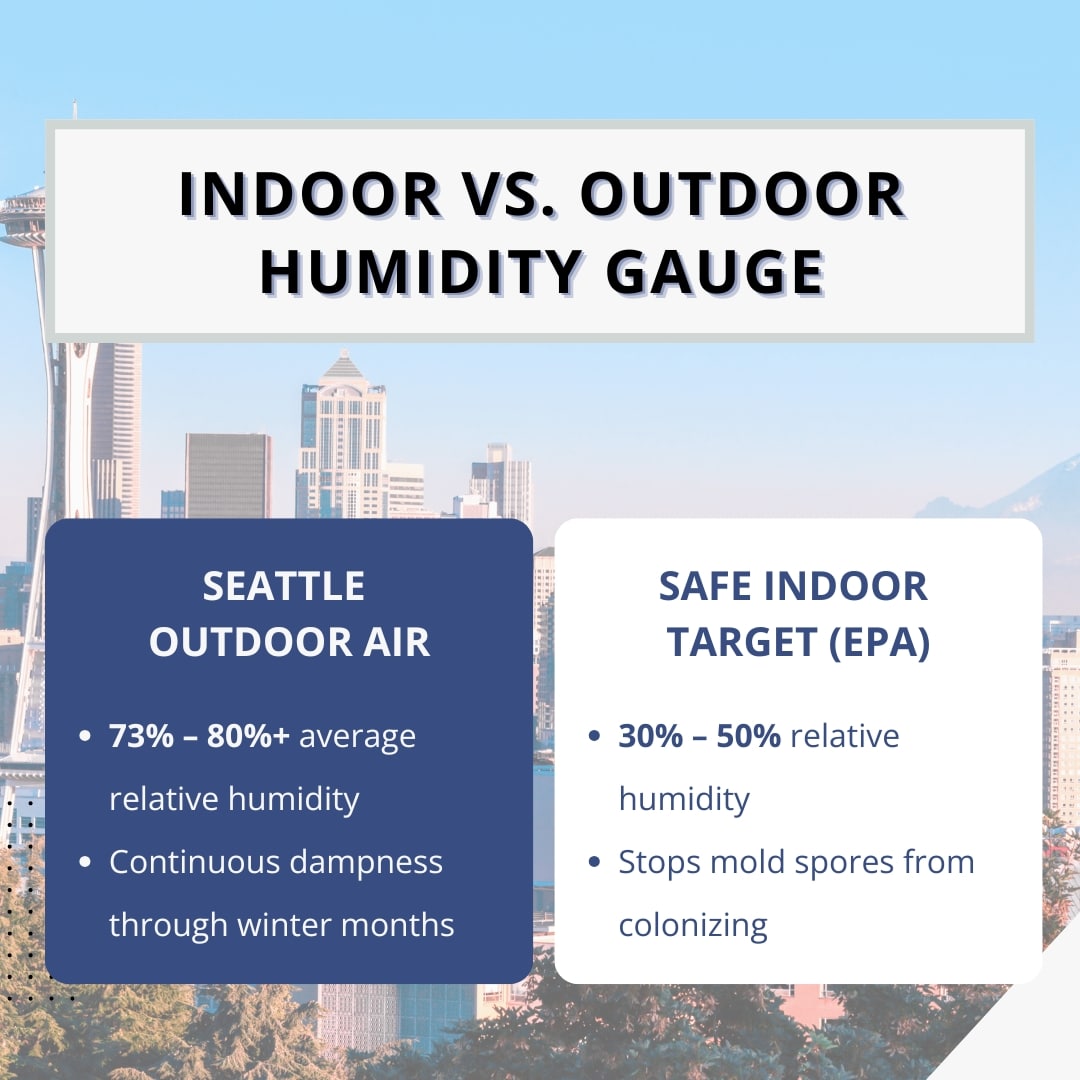
Yes, Seattle is humid, and that humidity is the main reason mold shows up in so many Pacific Northwest homes. The city sits at roughly 73% average relative humidity, climbing to 80% or higher through the wet winter months.
It rarely feels muggy, so the moisture is easy to ignore until a musty smell or a dark stain appears. At Pure View Property Inspections, we see the results of that hidden dampness in crawlspaces, attics, and bathrooms across the Seattle area every week.
This guide explains why our climate feeds mold, where it hides, how to keep it out, and what happens during a professional mold inspection.
Is Seattle Really That Humid? What the Numbers Say
Seattle is genuinely humid, even though it does not feel tropical. Average relative humidity runs near 73% for the year, with monthly figures dipping to around 60% in early summer and rising to 80% or more in December and January. Dew points stay moderate, usually below 65°F, which is why the air feels cool and damp instead of sticky.
That difference matters. Mugginess comes from a high dew point. Mold, on the other hand, responds to relative humidity, and Seattle keeps relative humidity high for months at a time. Add about 37 inches of annual rain, cool temperatures, and short winter days that limit drying, and you get long stretches where surfaces never fully dry out.
Mold grows best between 60°F and 80°F, and Seattle sits in that range for much of the year. So the popular idea that “Seattle isn’t humid” is a myth built on how the air feels, not on what the instruments read. For your home, the reading is what counts.
How High Humidity Turns Into a Mold Problem
Mold needs three things to grow: mold spores, a food source, and moisture. Spores float in the air everywhere, and building materials like drywall, insulation, and wood framing are food. The only factor you can realistically control is moisture, which is exactly why humidity drives the problem.
Two numbers explain most Seattle mold cases:
- 60% relative humidity. The U.S. Environmental Protection Agency advises keeping indoor humidity below 60%, and ideally between 30% and 50%, to limit mold growth. You can read the agency’s full guidance in its overview of mold, moisture, and your home.
- 24 to 48 hours. When materials get wet and are not dried within one to two days, mold can begin to colonize. In a damp climate, that window closes fast.
The trouble is that humidity does not need a leak to cause damage. When warm, moist indoor air meets a cold surface, such as a single-pane window, an exterior wall, or the underside of the roof sheathing, water condenses right there.
That condensation feeds mold in spots you never see, which is how a “clean” looking home can still develop a problem behind the scenes.
Where Mold Hides in Seattle and Pacific Northwest Homes
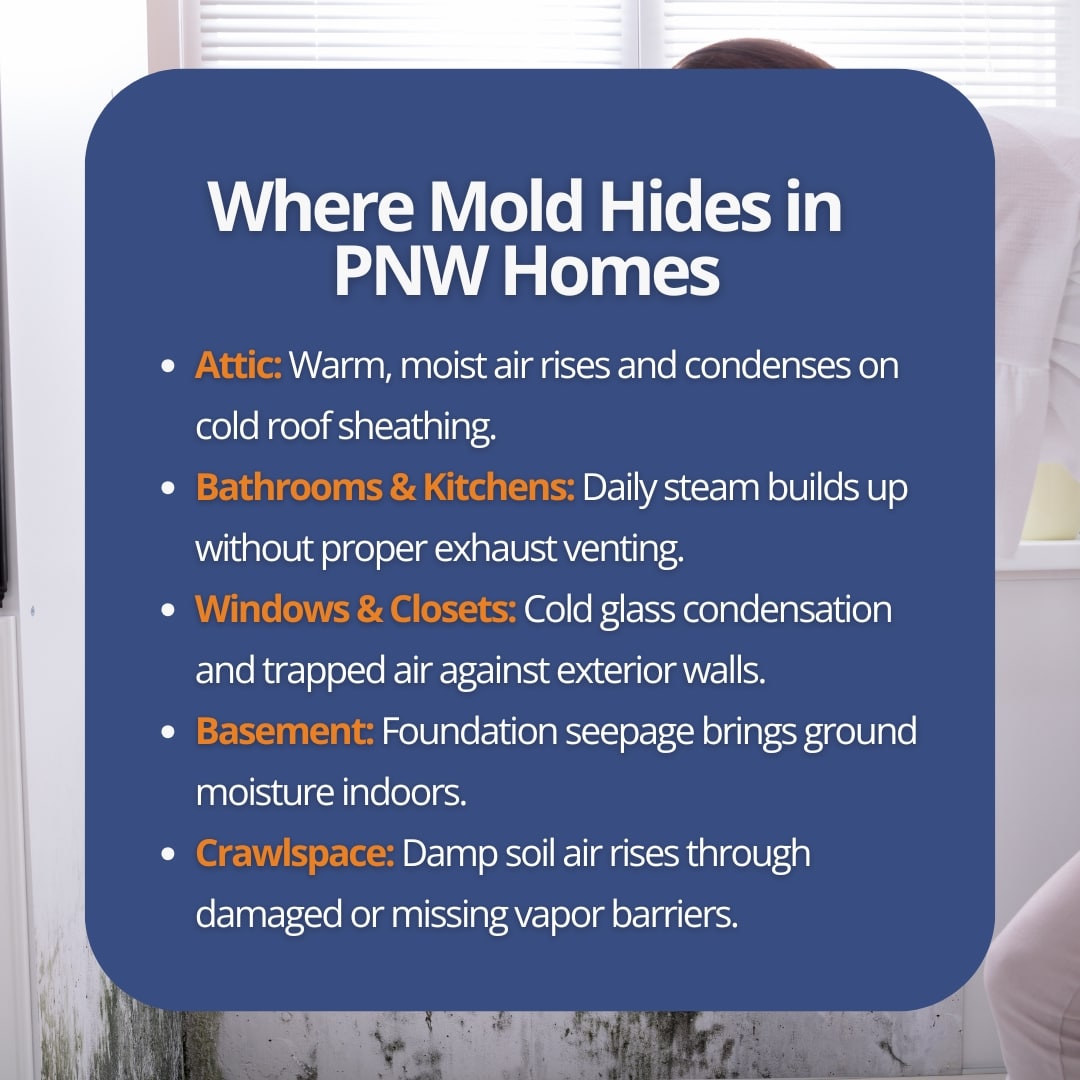
In local homes, mold tends to concentrate in a handful of predictable places where moisture collects, and air does not move.
- Crawlspaces. Vented crawlspaces under older PNW homes trap damp ground air. A torn or missing vapor barrier lets soil moisture rise into the framing, one of the most common issues we find.
- Attics. Tightly sealed winter homes push warm, moist air upward. With poor ventilation, that moisture condenses on the cold roof sheathing and can even show as frost, then feeds mold as it melts.
- Basements and lower levels. Below-grade walls stay cool, and homes on Seattle’s hillsides or near low-lying areas can take on groundwater through foundations.
- Bathrooms, kitchens, and laundry rooms. Daily steam and a weak or missing exhaust fan keep relative humidity high in these rooms.
- Windows and closets. Condensation on glass and still air in closets on exterior walls create quiet mold pockets.
Pre-1960 homes carry extra risk because of vented crawlspaces, aging vapor barriers, and drainage that was never designed for today’s standards. Many of these show up in the common problems our inspectors find in older Seattle homes.
Warning Signs Your Home Has a Moisture Problem
You can often catch a moisture problem before it spreads by watching for a few clear signals.
- A musty or earthy odor, especially in a crawlspace, basement, or closet.
- Visible discoloration or staining on walls, ceilings, or grout, ranging from black to green to white.
- Condensation on windows or water beading on walls and pipes.
- Peeling paint, bubbling drywall, or warped wood and baseboards.
- Allergy-like symptoms that ease when you leave the house.
One nose test worth trusting: if a room smells musty even when it looks clean, moisture is likely hiding behind a surface. That is a good moment to measure indoor humidity with an inexpensive hygrometer and see whether you are living above 60%.
What High Humidity and Mold Can Do to Your Health
Mold exposure can affect health, especially for people who are sensitive to it. According to the Centers for Disease Control and Prevention, mold can trigger a stuffy nose, wheezing, and red or itchy eyes or skin, and reactions can be stronger for people with allergies, asthma, or weakened immune systems. You can review the CDC’s mold health information for the full picture.
Some molds, including the dark-colored Stachybotrys, often called “black mold,” can produce mycotoxins, while common household types such as Cladosporium, Penicillium, and Aspergillus are more likely to cause everyday allergy symptoms.
Rather than trying to identify a species by sight, treat any persistent musty smell or visible growth as a signal to find and fix the moisture source. Health effects are real, but the fix is almost always about controlling water, not chasing a specific mold.
How to Control Indoor Humidity and Prevent Mold
Keeping indoor humidity between 30% and 50% is the single most effective way to prevent mold. Moisture control is mold control. Here is how to hold that line in a damp climate:
- Track it. Put a hygrometer in problem rooms and watch for readings above 60%.
- Run a dehumidifier in crawlspaces, basements, and any room that stays damp.
- Use exhaust fans during and after showers and cooking, and confirm they vent outside, not into the attic.
- Dry wet materials within 24 to 48 hours after any spill, leak, or flood.
- Improve airflow by keeping HVAC running, opening interior doors, and pulling furniture slightly off exterior walls.
- Manage water outside with clean gutters, downspouts that carry water away, and grading that slopes away from the foundation.
- Seal the crawlspace. A sound vapor barrier or full crawlspace encapsulation blocks ground moisture from ever reaching the framing.
- Choose mold-resistant materials such as mold-resistant drywall when you remodel damp areas.
None of these steps require special skills, and together they remove the moisture mold depends on.
What to Expect During a Professional Mold Inspection
A professional mold inspection is a structured process to find where moisture is coming from, whether mold is present, and how far it has spread. Here is what happens from start to finish.
Before the visit, your inspector asks about musty odors, past leaks, recent water damage, and health concerns, then plans which areas to check.
During the inspection, the inspector performs a visual assessment of high-risk areas, then uses tools you cannot rely on by eye alone:
- Moisture meters read dampness inside walls, floors, and framing.
- Thermal (infrared) imaging reveals cool, wet areas behind surfaces without cutting anything open.
- Moisture mapping traces the water back to its source, which is the part that actually solves the problem.
If testing is warranted, the inspector may collect samples. Air sampling measures spore counts in the air, and surface sampling swabs a suspect spot. Samples go to a lab with a documented chain of custody, and the results come back as a written report.
After the inspection, you receive a clear report with photos, moisture findings, any lab results, and recommended next steps. If active mold is confirmed, that report guides remediation, the cleanup process that may include containment and HEPA filtration to keep spores from spreading.
One honest point: if you can already see or smell obvious mold, the EPA notes you often do not need a test to confirm it, since you already know cleanup is needed. The real value of an inspection is finding the hidden moisture source and the mold you cannot see. At Pure View, our mold inspections and air quality testing across the Seattle area focus on exactly that.
For a broader picture of what a full property visit covers, see our step-by-step guide to a Seattle home inspection.
Related Questions to Explore
Is Seattle actually humid, or does it just feel that way?
Seattle is truly humid, with an annual average near 73% relative humidity and winter readings of 80% or higher. It simply does not feel muggy because dew points stay moderate. The air is damp and cool rather than sticky, and that damp is what feeds mold.
What indoor humidity level causes mold to grow in a home?
Mold growth becomes likely once indoor relative humidity climbs above 60%. The EPA recommends keeping it below 60%, ideally between 30% and 50%. A simple hygrometer tells you where your home stands.
Why are Pacific Northwest crawlspaces and attics so prone to mold?
Crawlspaces trap damp ground air, and a torn vapor barrier lets soil moisture into the framing. Attics collect warm, moist household air that condenses on cold roof sheathing when ventilation is poor. Both spaces stay dark, still, and damp, which is ideal for mold. Our post on whether a home inspection checks for mold explains how inspectors catch these early.
How long does it take mold to grow after water damage?
Mold can begin to grow within 24 to 48 hours of materials getting wet. That is why drying floods, leaks, and spills quickly is so important, especially in a climate where surfaces are slow to dry on their own.
Do I need a mold test if I can already see or smell mold?
Usually not. The EPA points out that if mold is already visible, testing rarely changes what you need to do, because cleanup is required either way. A professional is most useful for finding the moisture source and any hidden growth behind walls or under floors.
When to Call a Professional
Call a professional when the problem is bigger than a quick wipe-down or when you cannot find where the moisture is coming from. As a rule of thumb, the EPA suggests that mold covering more than about 10 square feet is a job for experienced help.
Reach out to a mold inspector if you notice a lingering musty smell with no visible cause, repeated condensation or staining, moisture in a crawlspace or attic, or allergy symptoms that improve when you leave home.
It is also smart to schedule an inspection before buying a Pacific Northwest home, after any flood or major leak, and any time a standard home inspection flags elevated moisture.
Pure View Property Inspections serves Seattle, Kirkland, Bellevue, Kenmore, Bothell, Everett, and nearby communities, and we use infrared cameras, moisture meters, and air sampling to find problems others miss. You can learn more about our Seattle home inspection services or reach our team directly.
Conclusion
Seattle’s damp climate is the quiet engine behind most local mold problems, but it is manageable once you understand it.
- Keep indoor humidity between 30% and 50%, and act on any reading above 60%.
- Watch the high-risk spots: crawlspaces, attics, bathrooms, and windows.
- Dry wet materials within 24 to 48 hours, and call a professional when the moisture source is hidden, or the growth is large.
If a musty smell, a stain, or a past leak has you wondering what is happening behind your walls, a professional mold inspection gives you a clear answer and a plan. Schedule a mold inspection with Pure View Property Inspections and get the peace of mind of knowing exactly where your home stands.